


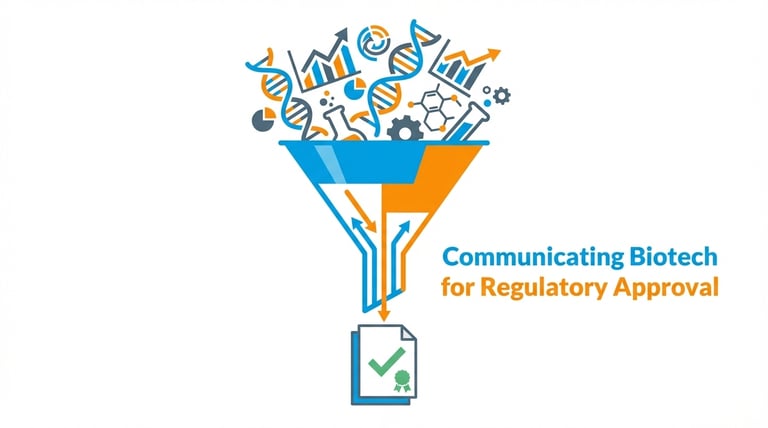
Effective communication in biotech regulatory meetings requires leading with your outcome, structuring your data around what reviewers need to make a decision, and preparing your team to handle the Q&A with the same rigor as the submission itself. The path to approval runs through clarity, not volume.
What You'll Learn
This article provides a strategic framework for communicating complex biotech innovations to regulatory bodies. You will discover how to:
- Understand the unique communication challenges in regulatory environments.
- Prepare your data and team for high-stakes presentations.
- Structure your message around what decision makers need using the Executive Framework from Speaking Up: Presenting to Decision Makers®.
- Implement actionable strategies to build clarity and trust with review panels.
- Confidently manage the question-and-answer portion of your meeting.
The Critical Role of Communication in Regulatory Approval
In the biotechnology sector, a regulatory meeting is more than a presentation; it is a pivotal checkpoint on the path to market. The way you communicate your innovation to agencies like the FDA or EMA can directly influence timelines, requests for additional data, and the ultimate approval of a new therapy or device.
The challenge is that regulatory reviewers operate under a different set of priorities than the scientists who built the data. They are focused on public safety, product efficacy, and regulatory alignment. They are not evaluating your research for its scientific elegance; they are evaluating whether your evidence supports a clear and defensible decision. Presentations that bury the conclusion in methodology or overwhelm reviewers with unfiltered data often generate more questions, not fewer. Clarity has to be built in from the start.
Laying the Groundwork: Audience and Preparation
Thorough preparation is the foundation of effective regulatory communication. This begins with a deep understanding of your audience: the regulatory reviewers. These are scientists, clinicians, and statisticians who scrutinize every detail. Your presentation must be tailored to their specific roles and anticipated concerns.
Before any meeting, your team should align on the core message and the supporting evidence. This involves creating a comprehensive submission dossier, which includes all preclinical and clinical data, and ensuring everyone presenting is familiar with its contents. A key component of this preparation involves anticipating potential questions about everything from bioavailability studies to Good Manufacturing Practice (GMP), the standards ensuring product quality and consistency.
Preparation also means knowing what you are asking for. Every regulatory presentation should have a clearly stated outcome: what decision you need, by when, and what evidence supports it. That outcome should open the presentation, not close it.
Leading With the Bottom Line
Most scientific presentations are built to culminate in a conclusion, walking the audience through the full arc of research before arriving at the finding. Regulatory reviewers do not have the patience or the mandate for that structure. They need to know what you are asking and why the evidence supports it before they can engage with the details.
The Executive Framework taught in Speaking Up: Presenting to Decision Makers® applies directly here. Open with your outcome: what you are seeking approval for and the specific evidence base that supports the claim. Then provide only the data that is critical to that decision. For a therapy in late-stage trials, that means connecting your clinical findings to patient outcomes, safety profile, and regulatory standards, not walking through every data point in sequence.
For example, instead of leading with the mechanism of pharmacokinetic data, open with what the data confirms about dosing safety and efficacy, and why that meets the agency's standard. Keep the technical detail available for questions, but do not lead with it.
The 10/30 Rule is a practical guide: in a 30-minute slot, structure 10 minutes of focused content and leave the remaining 20 for dialogue. Regulatory reviewers ask questions. That exchange is where trust is built, not the prepared remarks.
Building a Narrative That Supports the Decision
Raw data does not speak for itself. Regulatory reviewers process large volumes of submissions; a presentation that gives them a clear through-line is far more effective than one that requires them to construct the story on their own.
Structuring your presentation around the patient journey is one approach that works well in regulatory contexts. It makes the clinical relevance of your data visible without requiring reviewers to infer it. A well-designed narrative connects the unmet need, the evidence of safety and efficacy, and the regulatory pathway into a single coherent case, one that makes the path to approval clear.
For medical devices, linking your design assurance testing directly to the outcome you are seeking helps reviewers understand both what was done and why it matters to their decision.
Clean, purposeful visuals reinforce the narrative without adding complexity. Every slide should advance the decision, not document the research process.
Preparing for Difficult Dialogues
Regulatory meetings are rarely linear. Reviewers may challenge your statistical methodology, question your patient population selection, or raise concerns about Good Manufacturing Practice compliance at any point. These are not obstacles; they are the conversation. Your team's ability to handle them with clarity and confidence is as important as the submission itself.
The PREP model (Position, Reason, Evidence, Position), developed as part of our Speaking Up: Presenting to Decision Makers® program, is a reliable structure for responding under pressure. It keeps answers focused, evidence-backed, and direct, which is exactly what regulatory reviewers expect. For questions your team cannot answer on the spot, commit to a specific follow-up rather than speculating. Reviewers respect precision over breadth.
Active listening and reframing questions are equally important. When a reviewer raises a concern, paraphrasing it back before responding confirms alignment and gives your team a moment to organize the answer. It also signals that you understand the regulatory perspective, not just the scientific one.
Your team should prepare for the hardest questions before the meeting. What will the panel push back on hardest? Where is the data thinnest? What is the most likely source of delay? Walking through those scenarios in advance, and building PREP responses for each, changes the dynamic of the Q&A from reactive to controlled.
How Speaking Up: Presenting to Decision Makers® Develops These Skills for Regulatory Teams
Speaking Up: Presenting to Decision Makers® was built specifically for professionals who need to communicate with senior decision makers in high-stakes environments. The program is grounded in research from interviews with over 50 C-level leaders from Fortune 1000 companies and has been adopted by organizations including Genentech and Abbott Laboratories.
For regulatory teams, the program develops the specific skills that make the difference in an agency meeting:
- Executive Mindset Awareness: Understanding how decision makers evaluate information and learning to frame your message around what they need to act, not what you know.
- The Executive Framework: A structured approach to opening with the outcome, supporting with targeted data, and closing with clear next steps and confirmed agreements.
- Dynamic Dialogue Skills: Practice managing objections, unexpected pivots, and challenging questions using the PREP model and active-listening techniques.
- 1:1 Coaching: Personalized feedback on message clarity, delivery, and presence in real-world scenarios.
- Digital Learning Reinforcement: Access to PowerSpeaking Inc.'s videos for ongoing skill development beyond the live workshop.
A Framework for Your Next Regulatory Meeting
Before your team walks into the room, use this four-step process to prepare.
- Define the Decision and State It First: What are you asking the agency to approve, clear, or advance? Write it as a single, precise sentence with the supporting evidence attached. That is your opening.
- Select Only the Data That Supports the Decision: Cut everything that does not directly justify your ask. For each data point you keep, prepare a plain-language explanation and connect it explicitly to the regulatory standard it satisfies.
- Structure for Dialogue: Plan your structured content to fill roughly one-third of the allotted time. Leave the rest open. End with a summary that confirms what was agreed and what the next steps are.
- Prepare for the Hardest Questions: List the top five challenging questions you expect the reviewers to ask. Build PREP responses for each. Know how you will handle a last-minute scope change or an unexpected line of questioning without losing your core message.
The Path Forward: Building Trust Through Clarity
Effectively communicating biotech innovations in regulatory meetings is a specialized skill. The teams that succeed are not the ones with the most data; they are the ones who can present the right data to the right audience, in a structure that makes the decision obvious. By leading with the outcome, applying the Executive Framework, and preparing your team to handle challenging dialogues with confidence, you build the kind of trust that moves submissions forward on schedule. That skill set is worth developing well before your next high-stakes meeting.
Frequently Asked Questions
Why is effective communication so important in biotech regulatory meetings?
Regulatory reviewers are evaluating whether your evidence supports a clear and defensible decision, not the depth of your research. An unclear presentation or data that is not connected to the decision at hand can generate additional questions and delays. Presenting with precision and structure demonstrates command of the material and respect for the regulatory process, both of which build the trust needed to move a submission forward.
How should a biotech team structure a regulatory presentation?
Lead with the outcome: what you are seeking and why the evidence supports it. Then provide only the data critical to that decision, organized around the regulatory standards it satisfies. The Executive Framework from Speaking Up: Presenting to Decision Makers® is a practical guide: open with the bottom line, support with targeted evidence, and close with confirmed next steps. Plan for roughly one-third of your time to be structured content and the rest to be dialogue.
What are the core principles of the Speaking Up: Presenting to Decision Makers® approach for regulatory meetings?
The core principles are leading with the bottom line, using the Executive Framework to structure content around what decision makers need, developing executive presence to guide a conversation rather than deliver a lecture, and preparing for difficult dialogues using tools like the PREP model. The goal in any high-stakes meeting is to make the path to a decision as clear as possible for the people in the room.
How should a team prepare for the Q&A session in a regulatory meeting?
Identify the hardest questions in advance and build structured responses using the PREP model (Position, Reason, Evidence, Position). Practice active listening and reframing questions so the team can respond clearly under pressure. For questions that cannot be answered on the spot, commit to a specific follow-up rather than speculating. A well-prepared Q&A demonstrates full command of the material and builds confidence with the review panel.
Join Us in Conversation . . .

Communication That Transforms People, Cultures, and Business
Thursday, November 19, 2026, 9:00-10:00 a.m. PT; 12:00-1:00 p.m. ET; 5:00-6:00 p.m. BST

.png)
Keily Breeden
Engagement Executive & Head of HRAlignOrg Solutions
.png)
Kayla O'Rourke
Chief People Officer & Enterprise Transformation Executive
.png)

.png?width=270&height=360&name=PS%20Live%20Blog%20Sidebar%20CTA%20(31).png)