


I heard a quote recently that has really stuck with me.
“A closed mouth is a closed destiny.”
This was shared by a graduate of one of Asante Africa's programs, which is an organization devoted to providing educational services and support to underserved youth in East Africa.
“A closed mouth is a closed destiny” was a profound piece of wisdom his mother shared with him when he was a young, shy boy.
Her message was simple but powerful. If you don't speak your ideas, your hopes, your perspectives, if you keep them to yourself, they can't take shape in the world.
And I've been thinking about how often this shows up, not just in the big, life-defining moments, but in small, everyday situations . . .
In that meeting, when you hesitate to share your point of view.
During a presentation, when you hold back just ever so much, and don't fully own your message.
When you're in a conversation with a leader or a client, and you soften your words just a little too much.
It's not that you don't have something to say; it's that often, confidence gets in the way of how and whether you say it.
In this blog, PowerSpeaking, Inc. Facilitators Amy Furber, Ralf Wolter, and I unpack how you can communicate with confidence—in those big moments, those little moments, and everything in between.

Don't have time to read the whole guide right now?
Let us help you succeed with our guide to confident speaking, "The Confidence Habit: A Guide to Confident Speaking for Everyone." Save the PDF version to your desktop and read it when it's convenient for you.
(Direct download. No form required)

Content:
Confident Speaking: What It Is, and Isn’t
Manage Nerves With “The Roller-Coaster Reframe”
Express Confidence Through Your Delivery
Confident Speaking: What It Is, and Isn't
We’ve all seen them: the speakers who walk onto a stage (or join a Zoom call) and instantly command the room. It’s easy to assume these people were simply born with a "confidence gene." But that assumption is not only wrong, it can be a barrier to your professional growth.
Confidence isn’t a fixed personality trait. It’s a set of deliberate habits. Whether you’re an engineer presenting technical data or an introvert trying to find your voice in a meeting, you can learn to project a powerful presence.
Often, the first step is to deal with anxiety about presenting or public speaking.
We’d like you to think about “nervousness” in a different way.
Manage Nerves With “The Roller-Coaster Reframe”
One of the most common questions we get from workshop participants is, “How can I manage my nervousness?”
Start by understanding that the physiological response to anxiety—racing heart, sweaty palms, rapid breathing—is nearly identical to the response to excitement (as in joy and passion about your content!).
As Ralf puts it, the secret is to "make friends with the nerves." Instead of trying to suppress your anxiety, reframe it. Amy likes to use a roller-coaster analogy: When you’re standing in line anticipating that big drop, your body reacts with adrenaline. Yet while one person calls the feeling "terror," another calls it "thrilling."
So, next time you’re about to stand in front of an audience, if you tell yourself, "I’m excited to share this with them," or “I look forward to getting their insights,” you channel that nervous energy into your reason for being there.
Amy shares several strategies in this clip from a recent PowerSpeaking Live!:
Amy’s Quick Nerve-Calming Kit:
- Physical Movement: Shortly before your presentation or talk, take a walk, do jumping jacks, or use the stairs before a meeting to burn off excess adrenaline.
- The "Long Exhale": Breathe in, but make your exhale two seconds longer. This specifically triggers the nervous system to calm down.
Visualization: Don't visualize the "what if" of failure. Visualize yourself connecting with the audience and having fun.
Prepare, Prepare, Prepare
To show up with your best, relaxed, authentic self, you need to know your content inside and out, including rehearsals. The irony is, a high level of preparation frees you to be more confident, flexible, and engaged in the moment.
Another prep must: knowing your audience. How can you connect with them confidently if you don’t know their relation to your content or why they should care? Are they techies in the same specialty as you, or are they from a cross-section of the organization? How is what you’re proposing relevant to them? What would they most want to know to be inspired to action?
Now let’s put you in the room . . .
Avoid "Talk Traps"
Confidence is often undermined by subtle language patterns that signal doubt to the audience. These "talk traps" make even the most brilliant ideas sound weak.
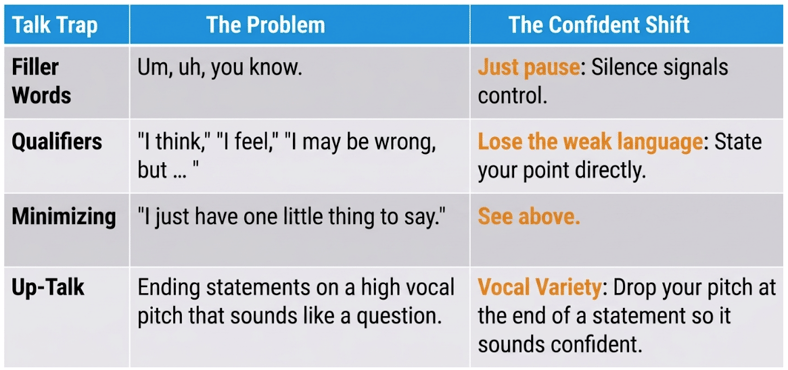
The reality is, if you don’t sound confident, how can you expect your audience to feel confident about what you’re presenting to them? Make sure your language habits boost your presence and impact, not detract from them.
Express Confidence Through Your Delivery
It’s not just your spoken language that demonstrates confidence. Body language and vocal range have a profound effect on how people perceive you.
Eye Contact: Where Connection Starts
Think about all of those times you sat through a presentation in which the presenter never looked away from their slides. Did they seem confident? Engaging?
No matter your personality type or delivery style, making genuine, inclusive eye contact with your audience demonstrates a powerful presence. There is no quicker way to show people you care about your content and its relevance to them than frequent, authentic eye contact. It also generates a great nonverbal feedback loop that can boost your confidence and keep you attuned to their reactions.
Vocal Variety and Gestures
When we’re telling a story or talking about something we’re passionate about, we’re all naturals at varying our tone of voice and using gestures to communicate excitement and illustrate a point. All we need to do is tap into that natural ability when we’re presenting or giving a speech.
To create vocal variety, modulate your voice between fast and slow, high and low, and use inflection to emphasize meaning. For example, notice what a difference inflection can make to the meaning of a sentence:
“The CUSTOMER will benefit most.”
“The customer WILL benefit most.”
“The customer will BENEFIT most.”
“The customer will benefit MOST.”
Of course, intentional movement and descriptive gestures are also important to keep your audience’s attention and accentuate your content. Contrast a presenter who is stiff and unmoving with one who moves around the room or stage. Or, one who draws a picture in the air to help you “see” the object they’re describing. These things make a big difference in how confident you appear.
So, find ways to vary your voice and use gestures that are natural to you.
In this clip, Ralf tells an interesting story about our client, Cisco, that demonstrates the power of confident delivery even to a highly technical audience.
Next, let’s look at a different scenario: developing the confidence to contribute in meetings.
Your Voice Matters at Any Table
Being a confident communicator isn’t just about presentations or public speaking. It’s also about everyday conversations and meetings. If you lack confidence in contributing or making yourself heard, here are our best tips.
Speak Early
Here’s a great anxiety ice-breaker: Say something in the first 10 minutes of the meeting to get past your fears early. The longer you wait to join the dialogue, the harder it will be to speak at all. Asking a question is a good way to participate and relieves you of the self-induced pressure to wait until you have something “intelligent” to add to the conversation.
Use Conversation "On-ramps"
To ease into a meeting discussion successfully, find a conversation on-ramp.
One of the easiest on-ramps is to use your voice to support others in the meeting. You might say, “I like Susan’s idea and can see where it would accelerate . . . “
But what if you want to interject an idea, a request, or a dissenting opinion? There are a number of on-ramp phrases that will help you do that. A few examples:
“I’d like to build on what [person’s name] just said...”
“This issue is new to me, so I’d like clarification on...”
“I see why that decision was made. Here are some new data insights...”
“I agree with [person’s name] in part, and I’d like to add that...”
“I disagree with what [person's name] has just said and believe...”
“I'd like to add a different perspective for us to consider…”
Keeping a short list of the on-ramps that feel natural to you can go a long way in boosting your confidence in meetings.
Final Thoughts
Ultimately, confident communication is about connection. If you don’t value what you have to say enough to share it, no one benefits.
Confidence is a practice. So, start by eliminating one qualifier from your vocabulary. Or, the next time you present, focus on making authentic eye contact. Or write down your top three meeting on-ramps and keep them in your pocket.
The best rewards in life come from stretching outside your comfort zone. What a shame to go through life holding back. You’re capable of so much more—and your voice matters.
As that little boy in East Africa learned, “A closed mouth is a closed destiny.”
Want to learn more?
Take advantage of this resource:
“Step Into Your Power: 10 Ways to Speak, Act, and Lead With Presence”
Join Us in Conversation . . .

Emotional Intelligence: The Heart of Communication
Thursday, September 17, 2026, 9:00-10:00 a.m. PT; 12:00-1:00 p.m. ET; 5:00-6:00 p.m. BST

.png)
Andrea Hoban
Relational Strategist and Executive Coach, EdTech Co-Founder


.png?width=270&height=360&name=PS%20Live%20Blog%20Sidebar%20CTA%20(29).png)