


.png?width=818&height=545&name=MockFrameworkv2%20(1).png)
Imagine trying to build a complex bridge without a blueprint or composing a symphony without capturing it on sheet music. It sounds absurd, yet every day in business, we attempt to communicate—in presentations, meetings, and even impromptu discussions—without a clear structure to make sure we’re being clear, concise, and compelling.
The best presenters and business communicators don't wing it. They use frameworks—proven blueprints that logically connect ideas, separate the "nice-to-haves" from the "must-haves," and make messages clear, easy to follow, and hard to forget.
If you avoid formal communication frameworks because you don’t want to appear rigid or inauthentic, reconsider. Think of frameworks as roadmaps or "cheat sheets" that actually free up brainpower so you can focus on your audience and be truly present in the moment.
Here is a collection of practical, powerful communication frameworks and tools you need to build your communication toolbox, some of which we use in our workshops. Try them out, then use the ones that feel most comfortable and authentic to you, depending on the situation.
Don't have time to read the whole guide right now?
Let us help you succeed with our guide on how to Use Proven Frameworks for Powerful Communication. Save the PDF version to your desktop and read when it's convenient for you.
(Direct download. No form required)

Content:
The Golden Rule: Audience and Outcome First
Frameworks for Everyday Communication
The Golden Rule: Audience and Outcome First
I can’t stress enough that before choosing any framework, it’s critical to ask yourself three fundamental questions:
- Who is my audience? What do they need to know, feel, and do?
- What is my core message? If they could remember only one sentence, what would it be?
- What is the desired outcome? What action do you want them to take?
The answers to these questions should be your North Star, because without them, your message likely won’t be clear, relevant, or persuasive.
And note that this exercise forces you to “start with the end.” By establishing the desired end state first, you ensure every piece of content you develop supports your desired action.
Here are a variety of frameworks that work.
Frameworks for Everyday Communication
These frameworks are designed for brief, clear, and versatile use in daily interactions, such as presentations, team meetings, one-on-ones, status updates, or impromptu responses—not to mention emails!
PREP Model (Position-Reason-Evidence-Position)
We use the PREP Model in many of our workshops because it’s excellent for impromptu moments or when you need to make a clear, brief, and persuasive argument quickly.
Position: State your position or recommendation immediately.
Reason: Give the main reason why.
Evidence: Provide a concrete example, data point, or statistic.
Position: Restate your position for reinforcement and a concise ending.
Example: Recommending a New Platform
"That’s a critical question. My position is that we should transition to the new 'Innovate' marketing automation platform by the end of Q1. The primary reason for this recommendation is the platform's native AI tools, which can automate 40% of the manual segmentation currently done by our team. The evidence from our pilot showed a 15% increase in lead quality with no additional staff hours required, proving its immediate ROI. Therefore, my position is that we move forward with the switch to 'Innovate' to gain a competitive advantage in lead management this year."
What, So What, Now What
This framework is highly versatile for status updates, quick reports, emails, or summarizing information. It ensures the audience understands the importance and next steps of the information presented.
What: State the facts or information.
So What: Explain why this information matters to the audience.
Now What: Suggest the next steps or action items.
Example: Status Update on Q3 Sales
"What: The Q3 sales data shows a 5% drop in revenue in the Northeast region. So What: This matters because the Northeast is historically our highest-margin market, indicating a problem with our new distribution channels. Now What: We need to immediately form a task force to audit the distributor contracts and plan a localized marketing campaign by the end of the month."
Vision-Past-Next (VPN)
The VPN framework is great for project updates and status reports. It ensures the update is strategic and remains focused on the overall objective.
Vision: Start with the project's goal or the "why."
Past: Talk about past conditions and challenges that are driving the vision.
Next: Detail the next steps or current focus.
I love the concrete example that Deb Aliprandi, communications consultant, shared in a recent PowerSpeaking Live! panel discussion:
The Elevator Pitch (Problem, Solution, Benefit, Call to Action)
This framework is ideal for inspiring action, especially in quick, persuasive situations. It structures the narrative to create an urgency and a clear path forward.
Lead with the Problem.
Present the Solution.
Detail the Benefit to the listener.
End with a clear, accessible, and often time-based Call to Action.
Example: Pitching a New Service to a Potential Client
"The problem is that your internal teams are spending 15 hours a week manually compiling compliance reports, time that could be spent on growth. Our solution is the 'Automate Pro' platform, which integrates with your existing tools to handle all compliance reporting automatically. The benefit to you is an immediate cost savings of over $50,000 a year, and your team gets to focus only on strategic work. Let’s schedule a 30-minute demonstration call next Tuesday to see it in action (Call to Action)."
Frameworks for Presenting to Decision Makers
These frameworks are designed for high-stakes presentations and executive briefings where the audience requires an immediate understanding of the recommendation, impact, and requested action. The core rule is Bottom Line Up Front (BLUF).
Bottom Line Up Front (BLUF)
When presenting to senior leaders where a decision is required, the most critical step is to lead immediately with the conclusion. This respects the limited time and high-level focus of decision makers.
- Your Request/Recommendation: "This is what I'm asking for."
- Positive Business Impact: "This is how it will positively impact the business."
Example: Executive Funding Request
"I am asking for $500,000 in immediate funding to launch Project Phoenix. This investment will positively impact the business by stabilizing our core platform's infrastructure, which is projected to prevent an estimated $1.2 million in potential system outage losses over the next 18 months."
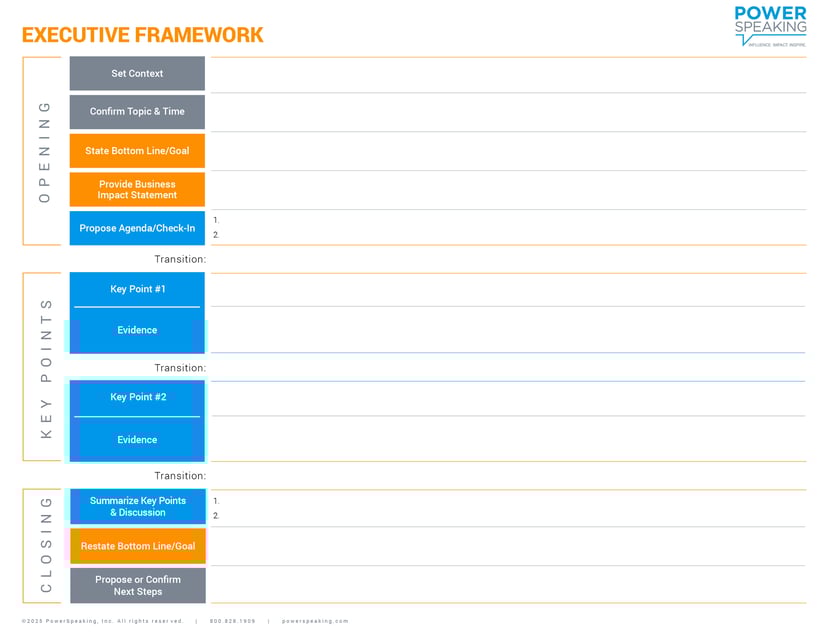
One of our long-time facilitators and coaches, John Warren, spoke to the importance of executive presentation frameworks in that same PowerSpeaking Live! panel discussion. He adds an important insight, which is that with C-Suite pitches, your framework needs to allow for a dynamic discussion.
In our Speaking Up: Presenting to Decision Makers® workshop, we go one step further by offering a thorough Executive Framework to help presenters think through and outline their presentation:
Frameworks That Tell a Story
Sometimes, a brief, compelling metaphor, analogy, or story is the most powerful way to illustrate an important point and inspire people to action.
These frameworks appeal to people’s logic and emotion, creating a compelling narrative.
Powerful Storytelling (Context, Challenge, Choice, and Result)
If you’re going to tell a story at work, it should do more than simply entertain. It has to have a purpose and a point. It needs to be brief. It must be audience-centric. And typically, the goal is to inspire some kind of action from the audience, whether it’s a change in perspective or buying into a project.
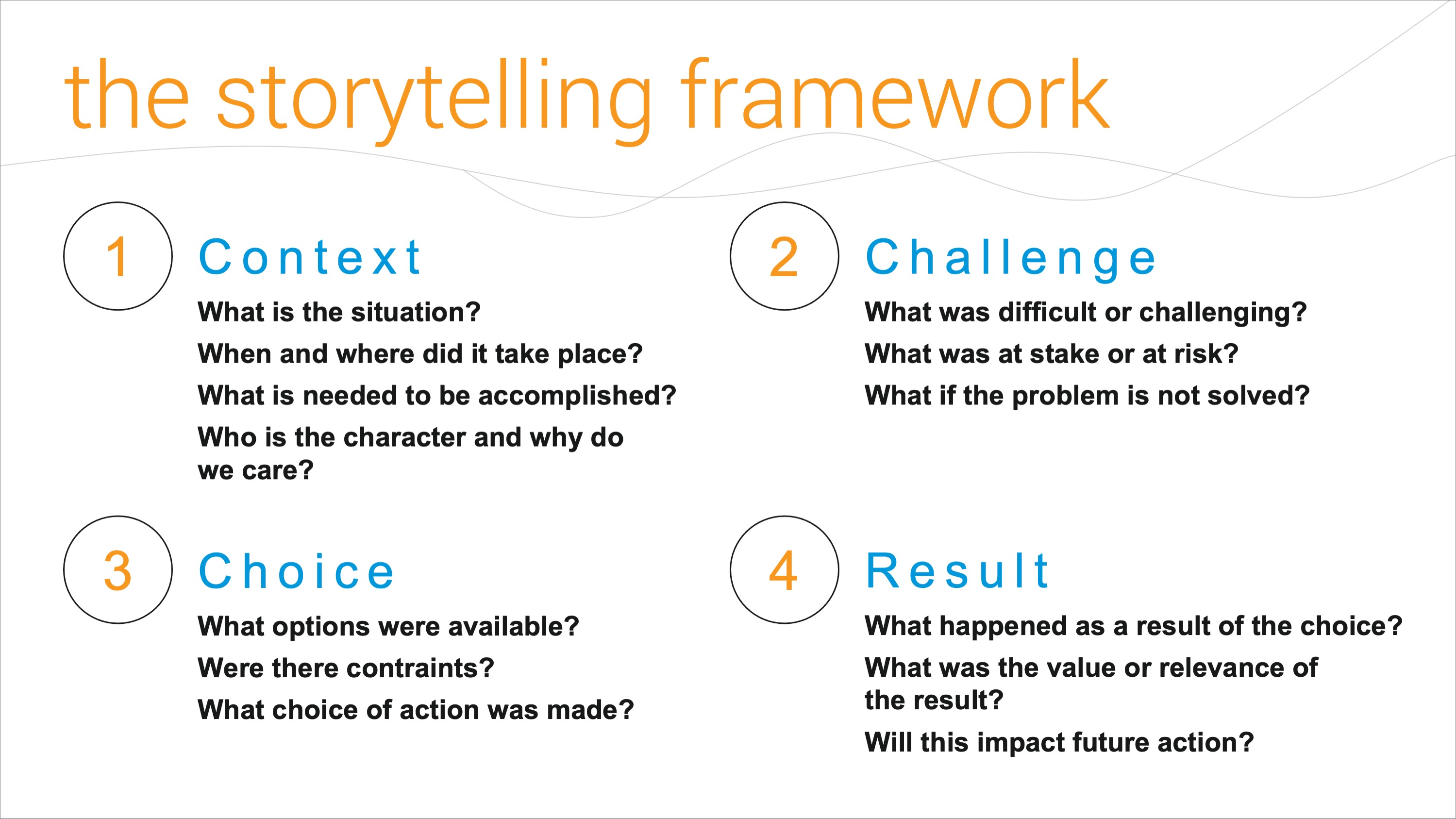
In our Powerful Storytelling™ workshop, we present a story-building framework tailored for business, which includes these four basic components: Context, Challenge, Choice, and Result.
Example: A Project Retrospective
"Context: For the last three years, our team relied on the legacy fulfillment software, which was stable but required five manual data entry checks for every order. Challenge: This system became a bottleneck when the Q3 sales volume spiked 40%, leading to an unacceptable 12% error rate and numerous customer complaints. Choice: We implemented the new automated batch-processing system last month. Result: Our error rate is now below 1%, and we have successfully processed the highest order volume in company history, ensuring we can sustain future growth."
The SEE Model (Statement, Evidence, Emotion)
Another framework is the SEE Model, which, like our storytelling model, is used to satisfy both the analytical ("left brain") and anecdotal ("right brain") sides of the audience, leading to maximum impact and retention:
Statement: Make your point.
Evidence: Back it up with logical evidence (data, facts).
Emotion: Bring it to life with anecdotal evidence (stories, metaphors, analogies).
Example: Arguing for Increased Training Budget
"Our staff is severely under-equipped to handle the new security threats (Statement). We've seen a 30% rise in phishing attempts over the last quarter, with three successful breaches requiring over 200 hours of recovery time (Evidence). Think of our current situation like having a beautiful, expensive house, but leaving the front door unlocked every night. We need to invest in a stronger defense (Emotion)."
Tips for Choosing and Practicing Frameworks
Build a Toolbox: Learn a small set of frameworks, then test them to see what suits your style and specific work context.
Practice With Low Stakes: The first time you try a framework, use it in a conversation with a family member or trusted colleague (e.g., trying to convince your family to get Mexican food over pizza using PREP). Ask for feedback: "How am I doing? Do you think I structured it well?"
Consider Cultural Differences: Frameworks are generally universal, but be extremely mindful of your word choices, metaphors, and story types to ensure they are relevant and well-understood by your specific audience.
Final Thoughts
In closing, I want to re-emphasize that these frameworks, used well, will not make you sound rigid or robotic. Just the opposite. They can free up your mental energy so you can focus entirely on your audience and be truly authentic and engaging.
When you know how to organize your thoughts clearly and quickly—whether it's an impromptu answer, a project update, or a critical pitch to the Board—you eliminate confusion and dramatically reduce wasted time.
We can all become better communicators at work. By committing to using powerful tools like frameworks, we can drive greater productivity, ensure our best ideas make the most meaningful impact, and build stronger, more trusting working relationships across the entire organization.
Resources
6 Top Communication Skills You Need to Succeed
Step Into Your Power: 10 Ways to Speak, Act, and Lead With Presence
Join Us in Conversation . . .

Emotional Intelligence: The Heart of Communication
Thursday, September 17, 2026, 9:00-10:00 a.m. PT; 12:00-1:00 p.m. ET; 5:00-6:00 p.m. BST

.png)
Andrea Hoban
Relational Strategist and Executive Coach, EdTech Co-Founder


.png?width=270&height=360&name=PS%20Live%20Blog%20Sidebar%20CTA%20(29).png)